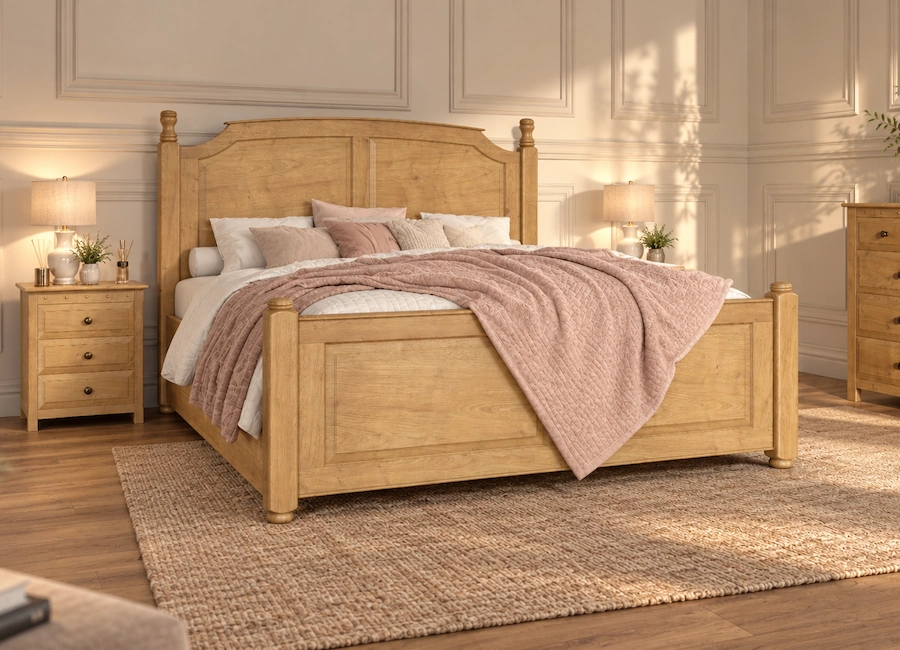
A bed gets more use than almost any other piece of furniture in the home. Night after night it supports the weight of a mattress and its sleepers, yet when choosing a new bed it’s often the headboard, colour and style that receive most of the attention.
What’s underneath matters just as much.
A properly made solid wood bed has a very different feel from a lightweight or flat-pack frame. There’s a solidity to it, but the real difference is in how it’s constructed. The timber, joints, side rails, slats and even the way the bed is designed to be delivered all play a part in how it performs over the years.
At Revival Beds, we’ve been making solid wooden beds in our Nottinghamshire workshop since 1983. One thing we’ve learnt in that time is that there isn’t a single feature that makes a bed last. It’s the combination of good timber, substantial components and proper construction.
What are the benefits of a solid wood bed?
Solid timber is particularly well suited to furniture that’s expected to work hard.
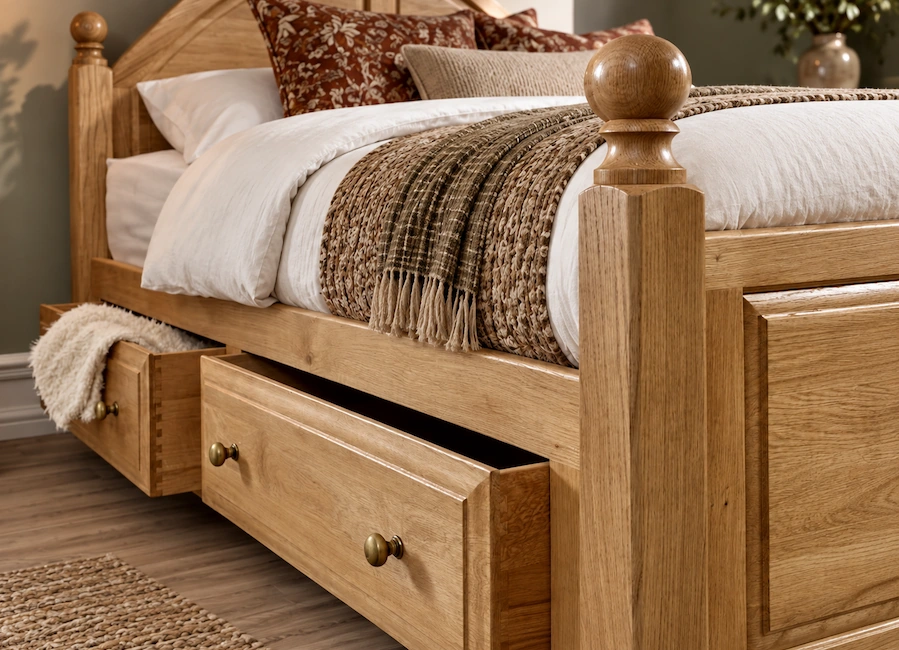
The structural parts of a solid wood bed are made from timber rather than thin composite boards covered with a decorative surface. This gives the frame substance, but it also allows traditional woodworking techniques to be used in its construction.
At Revival Beds, for example, we use traditional mortise and tenon joints in our beds. Pieces of timber are physically jointed together to create a strong structure designed to withstand years of everyday use.
Solid wood also ages differently from many manufactured materials. Small marks and changes in the timber can become part of its character, while the surface can be cared for and maintained over time.
Most importantly, a well-made wooden bed isn’t intended to be disposable furniture.
How long can a solid wood bed last?
There’s no sensible way to put an exact lifespan on every wooden bed.
A frame doesn’t automatically become strong or long-lasting simply because it’s described as solid wood. The quality of the timber, thickness of the components, construction of the joints and how the bed is treated all matter.
But a properly constructed solid wood bed should be a long-term purchase.
A bed also has to cope with repeated movement. Over time, lightweight fittings and poorly constructed joints can begin to loosen, which is when movement, squeaks and creaks can develop.
Good joinery and substantial timber help the frame behave as one solid structure.
It’s one of the reasons we’ve continued to use traditional construction methods for more than 40 years and why Revival beds are supplied with a 10-year guarantee.
Explore our solid wooden beds.

Don’t overlook the bed slats
One part of a bed that’s easily overlooked is the part you don’t normally see once the mattress is in place: the slats.
We get asked about them regularly.
A bed base needs to support both the mattress and its sleepers, distribute the load across the frame and provide a consistent platform beneath the mattress.
Revival beds use 18 solid pine slats, each approximately 70mm wide and 17mm thick, with gaps of around 40–45mm between them. The slats are also cloth-webbed to keep them securely positioned.
The spacing is important because a mattress needs consistent support while still allowing air to circulate beneath it.
There’s much more to the subject than simply choosing the largest possible number of slats, so we’ve put together a separate guide explaining which bed slats are best, including the differences between solid and sprung slats and why slat spacing matters.
If you’re buying a mattress separately, it’s also worth checking the mattress manufacturer’s requirements for the type of base and maximum permitted distance between slats.
What’s the difference between oak and pine bed frames?
Both can make excellent beds, but they have different characteristics.
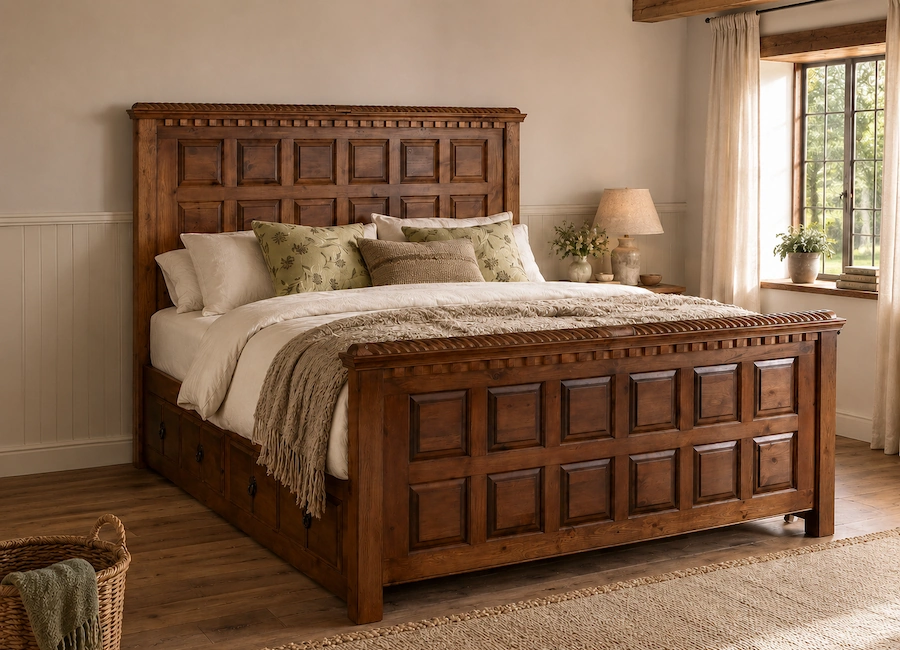
Oak is a hardwood with a distinctive grain and excellent resistance to everyday knocks and marks. It also has the substantial appearance many people associate with traditional solid wood furniture.
Pine is softer and will tend to develop marks and character more readily. It’s also generally less expensive than oak.
But pine shouldn’t automatically be associated with lightweight flat-pack furniture.
The quality of the timber and the way the bed has been constructed are far more important. Good-quality pine combined with substantial components and traditional joinery can make an exceptionally strong bed frame.
So rather than simply asking whether oak is better than pine, consider the appearance you prefer, your budget and how the bed itself has been made.
Can a solid wood bed be made to measure?
One advantage of making every bed to order is that we’re not restricted to taking finished frames from a warehouse shelf.
Revival beds are available in an extensive range of standard sizes, with many designs available from a 3’0″ Single right through to much larger Emperor and 8’0″ Caesar sizes.
But bedrooms aren’t always standard sizes.
You might have an alcove to work around, an unusually shaped room, a low ceiling, an especially tall mattress or simply want dimensions that aren’t readily available from a standard furniture retailer.
Because our beds are handmade to order, we can discuss bespoke widths, lengths and heights as well as alterations to individual designs.
The same principle extends to our bedroom furniture, mattresses and bedding.
Rather than making your bedroom fit a standard product, in many cases we can make the product fit your bedroom.
Find out more about our bespoke beds.
Will a super king or larger bed fit upstairs?
This is one of the most practical questions to ask before buying a large solid wood bed.
Your bedroom itself might comfortably accommodate a Super King, Eastern King, Emperor or Caesar bed, but the route to the room can be a different matter.
Narrow staircases, tight turns, landings, low bulkheads and awkward doorways all need to be considered.
We don’t leave that until delivery day.
If access looks as though it could be restricted, we’ll ask for measurements of the stairs and any particularly tight points. These can then be checked internally against the components that need to reach the bedroom.
It means we can identify a potential problem before your bed is made rather than discovering it when the delivery team arrives.
How do you get a large solid wood bed upstairs?
A large bed doesn’t necessarily travel through your home as one enormous finished piece.
Most of our beds are designed to be assembled in the bedroom because they are manufactured in kit form. For example, headboard and footboard posts are assembled on site rather than needing to negotiate the staircase as a large completed component.
Once everything has reached the bedroom, our specialist delivery team assembles the bed for you.
It’s one of the advantages of making the beds ourselves: we can consider how a particularly large bed will get into your bedroom while we’re manufacturing it.
That becomes increasingly useful with Super King, Eastern King, Emperor and Caesar beds, where both the bed and mattress can be considerably larger than the standard sizes many homes were originally designed around.
What if a large mattress won’t fit upstairs?
Sometimes the bed frame isn’t actually the most difficult part. It’s the mattress.
A conventional Super King mattress is approximately 180cm wide and, unlike a wooden bed frame, can’t simply be dismantled into smaller components.
One solution is a zip-link mattress.
Instead of one large mattress, a zip-link is supplied as two separate mattress sections. These are much easier to manoeuvre through the property and are zipped together once they’re in position on the bed.
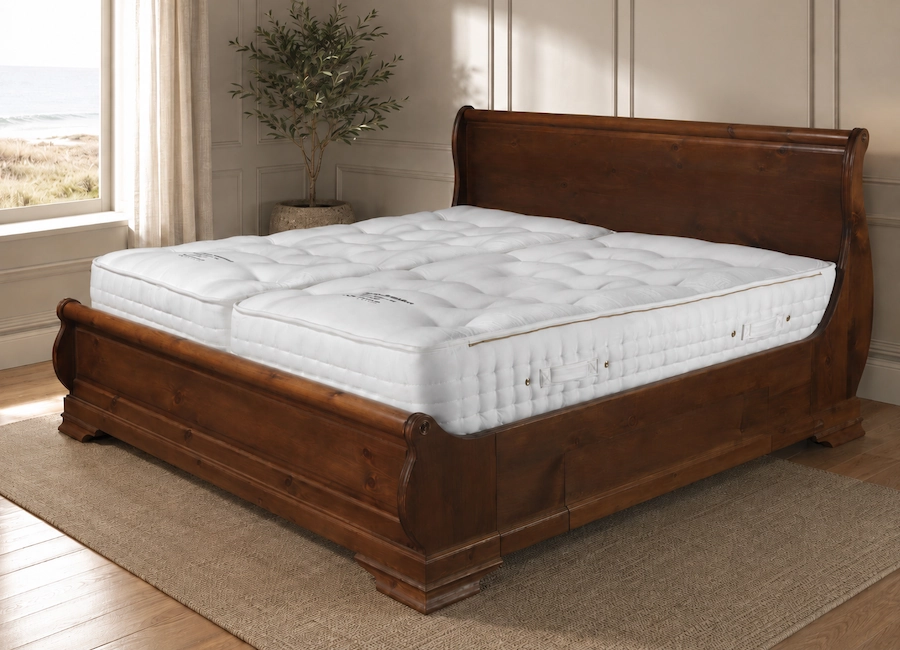
We recommend zip-link construction for Super King mattresses and larger where access is restricted.
However, we can also supply King size zip-link mattresses. That’s less commonly available but can be extremely useful in properties where access makes manoeuvring even a conventional King size mattress difficult.
So if you’ve ever dismissed the idea of a larger bed because you don’t think the mattress would get upstairs, it’s worth speaking to us first. There may be a much simpler solution than you expect.
Find out more about our made-to-measure and zip-link mattresses.
Delivery shouldn’t end at your front door
A substantial solid wood bed isn’t something we’d expect you to carry upstairs and assemble yourself.
Our own specialist two-person delivery team delivers and installs our beds and bedroom furniture in the room where they’re going to be used.
On the day of delivery, the team will bring the components into your chosen room, assemble the bed and remove the packaging.
If you’ve purchased a mattress at the same time, they’ll put that onto the bed for you too.
For UK mainland customers, delivery and installation of our beds, bedroom furniture and mattresses is included as part of the service.*
Because access has already been considered beforehand, the aim is for delivery day to be exactly that: the day you get your new bed, rather than the day everyone discovers it won’t fit up the stairs.
Read more about our delivery and installation service.
*Delivery and installation conditions and exceptions apply. See our delivery information for full details.
What happens to my old mattress?
Buying a new bed is often when people decide it’s time to replace their mattress as well.
And that creates another practical problem: what do you do with the old one?
If you purchase a new mattress from Revival Beds, we can remove your old mattress when your new one is delivered and arrange for it to be recycled for an additional fee.
It’s particularly useful with larger mattresses. Anyone who has tried manoeuvring an old King or Super King mattress down a staircase and then working out how to transport it will understand why.
It also means the old mattress can be dealt with responsibly as part of the same delivery.
Is a solid wood bed worth the investment?
If you’re comparing the purchase price alone, a handmade solid wood bed probably won’t be the cheapest way to furnish a bedroom.
That’s not really what it’s designed to be.
The value comes from buying something strong, maintainable and constructed with the expectation that you’ll keep it.
A good bed frame can remain while mattresses, bedding and even entire bedroom schemes change around it.
So when you’re comparing beds, look beyond the headboard.
Ask what timber has been used. Look at how the frame is joined. Ask about the slatted base and spacing between the slats. Find out how the bed will be delivered and assembled.
And if you’re considering a particularly large bed, don’t just measure the bedroom. Think about the entire route from your front door to where the bed will eventually sit.
At Revival Beds, we’ve been handcrafting solid wood beds in Nottinghamshire since 1983. Our beds are made to order, with bespoke options available, and delivered and installed by our own specialist team.
We can check difficult access before manufacture, adapt the way a large bed is constructed so it can be assembled in the bedroom, supply zip-link mattresses where access requires them and remove your old mattress for recycling when you purchase a replacement from us.
Because choosing the right bed isn’t only about how it looks.
It’s about how it’s made, how it supports you and your mattress, how it gets into your home — and how well it performs once it’s there.