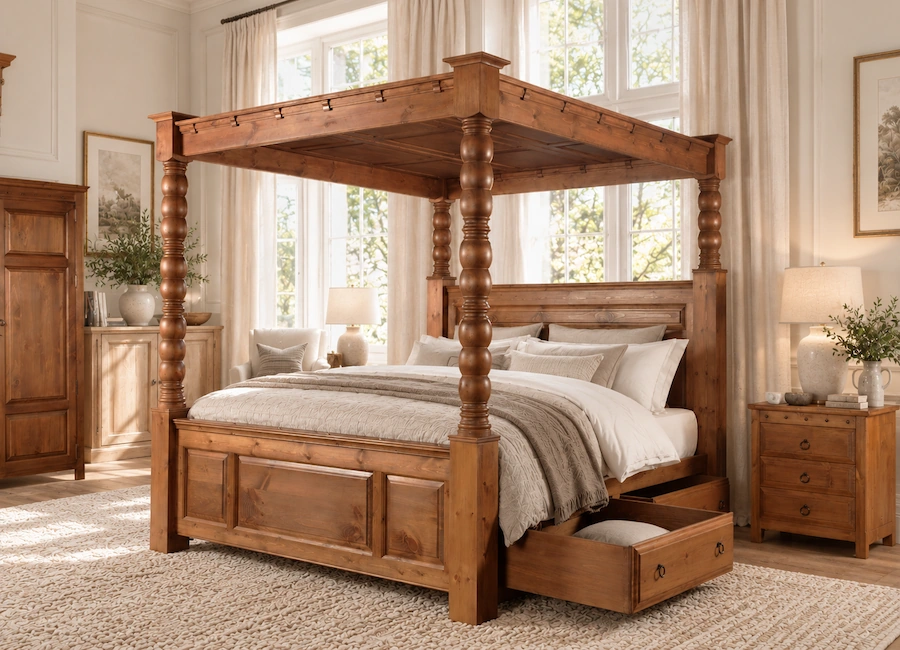
When you’re spending real money on a bed, it’s fair to ask whether pine is a serious choice. As a workshop that’s built beds in both pine and oak since 1983: a properly made pine bed is a genuinely good bed. Strong, long-lasting and full of character.
Why pine gets an unfair reputation
The flat-pack association does pine a real disservice. The timber in a boxed frame is usually fast-grown, low-grade softwood, which means wide growth rings, more knots and a softer, weaker board. Cut it thin, staple or bolt it together to hit a price, and of course it flexes, creaks and works loose. No wonder people come away thinking pine is weak.
That isn’t the pine we use, and it isn’t how we build. Our pine beds are made from a combination of Scandinavian Redwood and Quebec Yellow, both slow-grown, close-grained timbers chosen for strength as much as looks. There’s more on why those two woods matter if you want the detail. The short version: grade and construction are everything, and a cheap flat-pack frame has neither.
Is pine strong enough for a bed frame?
Yes. It’s the question we get asked most about pine, so let’s answer it properly rather than in a line.
Strength in a bed doesn’t come from the raw hardness of the timber, it comes from how the frame is put together. Every Revival pine bed is jointed with mortise and tenon, the traditional joint that locks two pieces of timber together with a peg-and-socket fit rather than leaning on screws that loosen over the years. The base is carried on 18 solid pine slats, each one 70 by 17mm and spaced 40 to 45mm apart for proper mattress support, cloth-webbed at the ends so they stay put and don’t rattle. Add the under-bed storage drawers and those are dovetailed by hand.
Put good-grade pine together like that and it will last decades. A well-built pine bed will comfortably outlast a cheaply made oak one. So if the worry is that pine won’t hold up, it will, as long as it’s solid timber and jointed properly rather than boxed and bolted.
Will a pine bed dent or mark?
This is where we’ll be straight with you, because it’s the one real trade-off. Pine is softer than oak, so it can take a knock or a scratch that harder oak would shrug off. Drop something heavy on a pine rail and it may leave a mark where oak wouldn’t.
For a lot of people that isn’t a problem, it’s the appeal. Those small marks are how pine earns its character over time, much like a well-used kitchen table, and they suit the warmer, more relaxed look pine has anyway. If you’d rather keep it looking newer for longer, the natural wax finish we apply helps resist everyday wear, and the softer surface is also easier to touch up than a hard oak one. If a knock-proof surface genuinely matters more to you than the character, that’s a fair reason to look at oak beds instead. If a bit of lived-in patina is welcome, pine’s a joy to live with.
How long will a pine bed last?
Decades, kept properly. A solid pine bed isn’t a throwaway, it’s a piece you’ll have for the long run, and we back every one with a 10-year guarantee, the same as our oak, plus a 21-day money-back promise if it isn’t right for you.
Looking after it is simple. Keep it out of direct sunlight and away from radiators so the timber doesn’t dry out, dust it with a dry, lint-free cloth rather than silicone sprays, and give it a wipe of clear beeswax every six months or so to feed the wood. That’s about the size of it. Our care guide has the full detail, but a pine bed asks very little of you to keep it going for years. And because pine grows faster than oak, it’s replenished more quickly, which is a quiet point in its favour.
Pine takes colour better than almost any wood
One of pine’s real advantages over oak rarely gets a mention: it’s wonderful to finish, and easy to change your mind about later. The grain is straighter and lighter, so it takes paint and wax evenly, which is why painted pine has moved in and out of fashion for generations. Fancy a different look in five years? Pine repaints far more happily than oak does.
Our pine beds come in four natural wax finishes: Kenilworth (a lighter tone, close to solid oak), Old Wood (a mid shade that brings out the grain), Antique Mahogany (a rich, dark, traditional colour) and Walnut (a striking dark finish). If you’re after white, black or grey, our colour-matching service can hand-finish to a shade you choose. Order free wood samples and you can see the finishes in your own light before you settle on one.
What decor suits a pine bed?
Pine is at its best in a room that’s warm and unfussy, with natural light, soft colours and a bit of texture. It sits beautifully with off-whites, sage and heritage greens, muted blues and warm neutrals, all of which let the honey tone of the wood come forward. If you want the timber to be the star, keep the walls quiet. If you’d rather it recede a little, a painted finish tones it right down.
For a scheme that works together, matching your bed to pine bedroom furniture, a chest, bedside cabinets or a wardrobe, is the easy route. We make over 30 pine bed designs, from chunky traditional frames to sleigh and four poster styles, so there’s usually one that fits the room you’ve got in mind.
So, is a pine bed right for you?
Choose pine if you want solid, properly made timber that’s warm, full of character and kinder on the budget than oak.
If the room’s an awkward shape or you need a size the high street doesn’t stock, we build everything to order from a 3’0″ single up to an 8’0″ Caesar, so a bespoke pine bed is no trouble at all. Order your free wood samples to see the timber and finishes for yourself, or book a showroom visit and we’ll talk you through the range in person. Every bed is handmade to order in Nottinghamshire, delivered and installed by us, and backed by that 10-year guarantee.