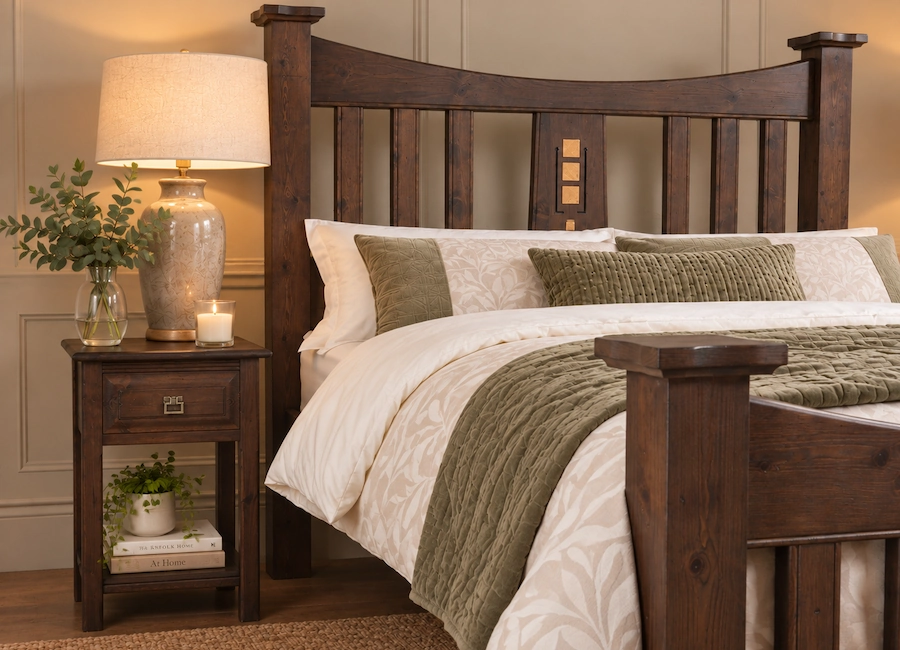
A bed frame can look impressive in a photograph, but its real quality is found in the details you cannot always see straight away: the timber, joints, slats, fixings and the care taken during delivery and assembly.

Those details matter because a bed works hard. It supports the mattress and its sleepers every night, and it may need to be dismantled and reassembled if you move home or redecorate. A well-made frame should feel stable, fit the room properly and continue doing its job without becoming an irritation.
Revival Beds has handcrafted wooden beds in Nottinghamshire since 1983. Here are the eight checks we recommend making before you buy.
1. Find out what the frame is actually made from
“Wooden bed” can describe very different products. Ask whether the main frame is made from solid timber, veneer, MDF, particleboard or a combination of materials. Product descriptions should make this clear.
Solid wood brings natural variation in grain and character, and it can be shaped, joined and finished by skilled makers. The species matters too, but there is no single correct choice for every customer.
Pine is a softwood with warmth and character. It is generally the more accessible option and works beautifully with traditional and painted finishes. Oak is a hardwood with a denser feel, a distinctive grain and a higher material cost. At Revival, the same care goes into the construction of our pine and oak beds, and both are covered by our 10-year bed-frame guarantee.
Whichever timber you prefer, ask where it has come from. Revival sources wood through FSC-certified suppliers, including Quebec Yellow pine, Scandinavian Redwood and European oak.
2. Look closely at the joints and fixings
A substantial-looking headboard does not tell you how securely the bed is held together. The connection between the side rails, headboard and footboard is one of the most important parts of the frame.
Ask the manufacturer or retailer:
- How are the main sections joined?
- Are the fixings metal or plastic?
- Can the bed be dismantled and rebuilt safely?
- Are replacement components available if they are ever needed?
Revival beds use self-tapping inserts and steel threaded bars at the leg joints. This dry assembly method does not rely on glue, so the frame can be dismantled and reassembled when required. Secure, accurately positioned fixings also help minimise movement between components — one of the common causes of a noisy bed.
3. Check the slats, not just the frame

The slats form the platform beneath the mattress, so their material, spacing and support are fundamental. Thin slats, wide gaps or weak fixings can allow excessive flexing and may not provide the support a mattress manufacturer expects.
Ask what the slats are made from, how many are supplied, how far apart they sit and how they are fixed. It is also sensible to check your mattress guarantee for any requirements concerning the base.
Every Revival bed is supplied with 18 solid pine slats. They are cloth-webbed near each end to keep them evenly positioned, then secured to the bed’s bearers through pre-drilled holes. Each slat measures 70mm by 17mm, with spacing of approximately 40–45mm.
On king-size beds and larger, a solid centre rail provides additional support through the middle of the frame. The exact support arrangement should always be appropriate for the bed’s size and intended use.
4. Consider the complete load, not just the sleepers
A bed supports more than body weight. The mattress itself can be heavy, particularly in larger sizes, and bedding adds a little more. The frame, slats and central support need to work together as a complete structure.
If you require an unusually large bed or have a specific support requirement, ask the manufacturer to confirm that the design is suitable before ordering. A reputable maker should be willing to discuss the frame’s construction and any additional support used for larger sizes, rather than relying on vague descriptions such as “strong” or “heavy duty”.

5. Measure the bed’s external dimensions
Double, king and super king describe mattress sizes, not the total footprint of every bed frame. A sleigh bed, a four-poster bed and a simple low-foot-end bed designed for the same mattress can occupy noticeably different amounts of floor space.
Check the full width, length and height of the bed, including the headboard, footboard, posts and any projecting details. Then mark that footprint in the room with low-tack tape. This makes it easier to judge walking space, drawer clearance, bedside furniture and the position of doors, radiators and sockets.
If a standard size is not quite right, ask whether a made-to-order manufacturer can adjust the dimensions. A carefully considered bespoke size may use the room better than compromising with a frame that is too dominant or leaves useful space wasted.
6. Plan the route into the bedroom
The perfect bed is no use if its largest components cannot reach the room. Before ordering, consider the complete delivery route:
- entrance doors and hallways;
- turns on the staircase and the height above them;
- bannisters, newel posts and sloping ceilings;
- bedroom door width;
- loft conversions or restricted upper floors.
Share photographs and measurements if you are uncertain. The important figure is not only the room size but the narrowest point and tightest turn along the route.
Revival beds are made in sections for delivery and are installed in the chosen room by our own specialist delivery team. Discussing difficult access before manufacture gives everyone the best chance to plan the right solution.
7. Ask who will assemble it
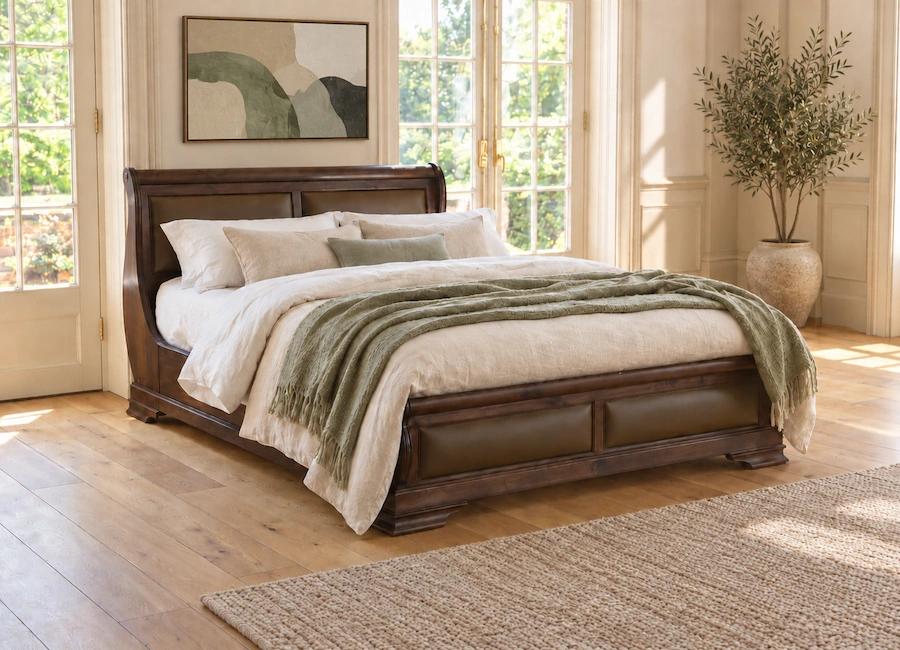
Even a well-made frame needs to be assembled correctly. Before buying, establish whether delivery includes installation, whether it costs extra and whether the work is carried out by the retailer’s own team or a third-party courier.
Professional installation is particularly valuable for large wooden beds, four posters and rooms with restricted access. It also gives the installer an opportunity to check that the frame is level, the fixings are secure and the slats and centre support are positioned correctly before the mattress goes on.
At Revival, our own delivery team installs the bed in the room, so the final stage is handled by people familiar with how it was made.
8. Read the guarantee — and consider who stands behind it
A long guarantee can indicate confidence in the product, but the number of years is only part of the story. Read what is covered, what is excluded and what the customer needs to do if a problem arises.
It is also worth considering the manufacturer’s history, contact details and aftercare. Can you speak to somebody who understands the product? Are replacement parts available? Will the business be able to advise you if the bed is moved or reassembled later?
Revival Beds has been handcrafting wooden beds since 1983, and every Revival bed frame is covered by a 10-year guarantee. Our team can also advise before an order is placed, when questions about size, access or finish are much easier to solve.

A simple quality-bed checklist
Before ordering, make sure you can answer these questions:
- What are the frame and slats made from?
- How are the main joints secured?
- How many slats are supplied, and how are they supported?
- Is the frame suitable for the mattress and intended load?
- What are the full external dimensions?
- Will every component fit through the delivery route?
- Who will deliver and assemble the bed?
- What does the guarantee cover, and who provides the aftercare?
Choose with confidence
Quality is not about one decorative detail or a fashionable finish. It is the combination of suitable materials, sound construction, proper mattress support, accurate sizing and dependable service.
Explore our handcrafted wooden beds, or order free wood samples to compare the timber and finishes in your own room. If you would like to discuss sizing, bedroom access or a made-to-order requirement, speak to the Revival Beds team before you order.